summary

Degrowing Poetics is an artist’s book made up of three volumes, in which I demonstrate different modes of doing research. The books Degrowing Essays [_], Artworks and Tools (o), and Making—Unmaking {} treat the theme of degrowing through different image, text and moving image registers, which become a personal critical re-configuration of my artistic research practice. As an artist-researcher, I explore ethics, systems-thinking, worlding-views, and poetics. I chose to use a tryadic arrangement to critique of the dominant institutional and bureaucratic cut between theory (writing) and practice (making).
Throughout the book, I elaborate a mode of practice with film, poiesis, and other life.[1] The research flows from three processes: a creative writing practice (Book (o)), photochemical experimental film practice (Book {}), and crafting a “living” theory (Book [_]). The connecting tissue between these acts of art is a turn towards the ecological, as well as the contradictions and relations involved in doing so. The research paradigm that I use in this book begins from place and our relations in the world. This paradigm can be traced back to different territories: Indigenous knowledge systems, feminist life-writing, auto-theory, auto-ethnography, fictocriticism, and process-relational philosophy. An important collaboration with microbiology allowed me to develop the concept of “poeisis from the milieu of practice” based on a fertile encounter between philosophy and biology.
Degrowing is defined for my purposes as intentionally reducing the energetic needs one holds against their environment. Degrowing is an organically occurring, cyclical process of regeneration, balancing, weathering, eroding, and spawning. But when it comes to the production of human cultural techniques, such as analogue imaging practices, degrowing also means critically investigating assumptions around what growth—and the accumulation of things—entails. Moreover, degrowth as a practice questions the mantra of economic “growthism” and replaces these economic practices with voluntary, simplicity, conviviality, and collective modes of resistance and living (Liegey and Nelson 2020). My focus in this book is on forms of poiesis that include more than ideas in human minds or language—forms that incorporate all relations in the world. Therefore, poiesis is less a matter of poetry than it is of making with other relations, other material, other life. The research task at hand is to answer the question: If degrowing implies doing less and making do with less through conviviality with humans and other life, then how do I adjust my ways of doing research and making film?
Research Propositions
In the three volumes of Degrowing Poetics, I distill an attitude towards making art with photochemical images, as well as towards doing research with non-human life forms, while being in good relations. As an artistic experiment, the inquiry takes place on the spectrum from stable to unstable, between stabilizing and collapsing. My research design moves towards knowingness, to avoid “operating through extremities of pre-prediction or staying in the comfort zone of what is already known” (Wilson and Bowman 2024).
The stable-unstable spectrum refers to my relationships, as well as the experimental systems I’m using. I acknowledge the vulnerability our work generates—things aren’t stable or certain. Some relationships in the book, such as the fungi-image relationship, are literal. Others, such as one with my ghostwriter Zoey Esther, are entirely fictional.
As an experiment in the iterative craft of theory-building (Rivard 2021), degrowing poetics aspires to explore the boundaries of the terms “experimental,” “ecology,” and “poetics” (poiesis) and push these towards an ethos of degrowth. Mirroring the metaphor of the spiral, I use different aspects of artistic theory-building to organize and elaborate Degrowing Poetics as a practicable foundation for a methodology. To achieve this, throughout the three books that constitute this work, I introduce my own field relations, I keep my artistic motivation transparent, I offer definitions for my concepts, I attempt to live up to the imaginative potential of my project, and I elaborate on how I make. This book is both the presentation of my research and a contribution to the field of practice research.
Degrowing Poetics works towards qualifying “degrowing” in three ways: degrowing as critical counter-ecology, degrowing as relational accountability and place-thought, and degrowing as a value-based protocol of care. I formulated and re-formulated research questions throughout the journey, which over time revealed to me what I had been exploring:
1. How does relational accountability towards sites, systems, and entities—such as soil fungi, chemical agents, and local plants—that exist at different scales and levels of cognition operate in artistic research in film?
2. How do analogue imaging practices respond when we open them towards other world-views that are equally valid and full of agency?
3. What is to be learned by treating the concepts of unstable image, degrowing, and poiesis as ongoing companions of artistic research? What are the consequences of this point of departure?
I also acted on some of the consequences of my inquiries by laying the foundations for a methodology that follows from the teachings and learnings of my own research—and in the books I craft them into a coherent protocol.
Relevance
In the view of this book, both cinema and ecology struggle to become part of “nature” or part of cultural technique. I will argue that they are neither; rather, they constitute an associated milieu. In many ways, this is a project about unmaking film and poetics in a way that is attuned to place, time, and other living and non-living forms so to understand what is left for re-generation. It’s an inquiry into being in the world, rather than representing the world, that is informed by the indigenous approach of place-thought. This book is itself a demonstration—my attempt to answer this question about ongoingness.
As a volume that discusses, glosses, and discloses artistic work as a practice of research, much of its contents may be transferred to the practices of other makers: visual artists, amateurs of film and photography, social and environmental scientists, students, and readers interested in the arts. As a material-social practice, albeit one that occurs in multiple, parallel sites and laboratories, the book will be of interest to anyone working with film, photography, choreography, sound art, and creative writing.
Degrowing Essays—Book [_]
Degrowing Essays creates a framework for thinking about and acting on degrowth. First, I offer a brief critical review of contemporary photochemical moving image practice. I define the boundaries of my interest through a search for the unstable–experimental–moving image, a need for connection to something beyond ourselves, and an interest in the “alterlife” of our infrastructures. I also assume that certain questions cannot be raised without the conditions and infrastructures of a darkroom-based practice. We can raise questions about pollution and toxicity and the ethics of biosemiotics precisely because we dip our hands into film developing buckets. There’s a direct, material messiness that leads to philosophical, ethical, and political inquiry.
Using the concept of associated milieu, I create a foundation for the open-ended, non-hierarchical construct of being ecology. To achieve this, I outline the genealogy of the phrase poiesis in the milieu of practice, and make a connection to an expanded definition of ecology. We could imagine ecology as a field of inhuman energy that cannot be tamed into lasting or comfortable shelter. There seems to be solid evidence from different sciences, both applied and theoretical, that causality can only be assigned retrospectively. What this means for an artistic research project, which works with the term “ecology,” is that the unplannable now becomes “scientific.” We must give up some of our artistic urge to control various “ecologies.” I provide answers to the questions—How much control is acceptable? and What is at stake when we give up some of it?—through different artistic forms over the course of the three volumes.
In Degrowing Essays, I offer the metaphor of milieu for ecology/poiesis, to help me build a theory from the practice itself. This metaphor contains the following elements: (a) time as circular; (b) the unromantic reading of nature, environment, and ecology; (c) a challenge to the perspectival order and individual subjectivity; (d) and artistic triggers for a systemic approach. Relying on Gilbert Simondon, I imagine poiesis in the milieu of practice as writing that is surfacing (affleurement) from an environment with other materials, concrete and atmospheric, human and more-than-human. These images (as relations) surface together with their associated milieu, transforming individual and milieu in the act. As living beings resolve these encounters (i.e. invention), a new cycle begins, one in which relations to the milieu are modified. Imagination is inevitable, vital, and relational. I explore these cycles in practical terms in the first and second stories in Book {}, Making—Unmaking.
In the second part of Degrowing Essays, I consider how poetics in the milieu can break open and transgress the fundamental order of things, however, I find myself slowly turning in a self-inflicted loop. My recognition of a blind spot first emerged in collaboration with photographer and researcher Risk Hazekamp, who introduced me to the practice of anti-colonial, feminist science through their photographic practice with Cyanobacteria (Ambrózy and Hazekamp 2025). I share the story of an insight that Indigenous scholar Vanessa Watts gave me, shedding light on the “western scientific” assumption that we should begin understanding the world by abstracting thought from life into praxis. This assumption places human progress at the centre of the universe, setting human agency above all other forms, turning methods into tools for human domination. I think therefore I extract.
I conclude that if degrowing poetics desires to become more than a patchwork of post-colonial theory of knowledge, it must cease to be a floating abstraction. Writing from the milieu needs to begin to fulfill its obligations and communicate with Place (and land). What are the ethical conditions for talking about place-thought? To find out, I follow the path of seeking advice. I contact Adrian Kahgee (Saugeen First Nation), founding member of Odeimin Runner’s Club (in Ontario, Canada), and ask for some of her time.
As our conversation unfolds, I wonder about the impossibility of “transferring” knowledge. The observations of the Saugeen nation’s knowledge keepers come from their land, their place, their cosmology, their elders. Their ways of relating to plants and animals have been passed down for centuries through stories, orally and mnemonically, until colonial violence reconfigured these relations. I was born into an oppressive political regime (in Hungary). As the empires of Europe erupted into violence, my grandparents on both sides of the family gave up fundamental freedoms, opportunity, and land because of their language, culture, and political beliefs. Observations about degrowing and archives in this book are essentially tied to my own cosmology, which has incorporated the many paths that I and my ancestors have taken.
As a form of synthesizing my insights, I develop two outcomes in Book [_]. First, a protocol of care for analogue imaging practices. Expanding on the idea of protocols as tools for change, I review the potential of working with pollution on a more systemic level. Contemporary humans co-exist with chemical exposures, given our simplest needs, such as eating and breathing. That microplastics have been found in breast milk and human ovary follicular fluid are facts we must come to terms with. We know little about life in general and the origins of life in particular. Rather than moralize about our own pollution, we ought to consider our accountability towards these larger systems. Toxic relations have always been part of us.
An urge to work with analogue images demonstrates how the concept of desire could be valuable for “interrupt[ing] the binary of reproduction versus resistance” (Tuck, 2009, 419). Using the term urge or desire moves beyond the dualistic idea that we reproduce, or blindly resist, our own oppression. My urge to take care of the optico-chemical machines and infrastructures of cinema is full of contradictions. I acknowledge that I desire to be conscious and desire to create with photochemical film at the same time. “It is our work to afford the multiplicity of life’s choices for one another,” rather than condemn an entire phenomenon (Tuck, 2009, 421). On my journey to degrow the toxic heritage of a practice, I come up against the issue of discarding.
To talk about discarding, I use a theory that can “grapple with complex systems characterized by inextricable difference, power dynamics, and complex scales” (Liboiron and Lepawsky 2022, 127; emphasis in the original). The basic premise is that discarding is a constitutive part of systems: “All systems discard, even good ones” (128). Systems discard to “hold together, to subsist, to persist” (127). So, for change to occur, the system needs to be differently organized, which can be achieved through “changing relationships that matter (relationships of scale)” (127). Across the three volumes, I demonstrate some applications of this theory in my research. One outcome of my inquiry is a co-crafted protocol, Degrowing Poetics—A Protocol of Care for Analogue Imaging Practices, that articulates a value-driven, ethically engaged, specific, place-based, relational environmental attitude, one that also stays in good relations with L/land.
The second outcome of the research is the Spiral Model. This model is a practicable foundation for a methodology, given that I built it iteratively from the experiences of doing degrowing poetics. As such, the model and its diagrams reflect a way of doing artistic research. The diagram operates with the constructs that I define and elaborate in the “Degrowing Glossary” and throughout the three volumes.
Making—Unmaking—Book { }
Making—Unmaking creatively documents the production of an experimental landscape film, Let Them Vanish With a Trace (2025) and the series of audio-visual performances seeds of degrowth (2024). They disclose the thinking-making process, subtly revealing gaps between the boundaries I set out, and the ethos to which a degrowing poetics aspires. Together with Book (o)—artworks and tools, this book is the empirical evidence, the intimate struggle, and the creative faltering that characterize research better than does a carefully curated, behind-the scenes photo documentation.
This book begins with and ends on short vignettes—first-person texts that qualify as creative non-fiction. Selected tightly and focused on disclosing my practice, they reveal moments of insight and tension that one goes through while working on artworks such as the ones presented in Book (o). In the middle of the book, I recount two stories. The stories disclose sustained collaboration with a scientist, an artist, two types of fungi, a garden, and my closest kin. These collaborations demonstrate the approach to research as a series of events—events that can be seen as an environment for poiesis, an environment in which experiences emerge from a field populated with energy.
The first story, Between Protocol and Ceremony, recounts the work with microbiologist Dovilė Vasiliauskienė. Working together through a series of lab meetings, we constructed setups to compare the degradation of 16 mm film in environmental and laboratory conditions. I built a compost pile, and she facilitated the work in a science lab. The process lasted ten months and we gathered data at multiple points. We consistently retrieved and documented film and microbiological samples from both setups. After ten months, we investigated what happened to the film frames.
In this story, we can trace the conflict between worldviews and observe “how relations themselves field experience” (E. Manning 2016, 30). While witnessing the emergence of the “creative” power of fungi, we found an illuminating pause in our own protocols, a pause that turn the act into a small ceremony of honouring the dexterity of our fungal ancestors. Our samples (science) and traces (art) and overall process are humble in terms of our energetic demands and carbon footprints: in total, we used under one minute of 16 mm film in the lab, and about two minutes of film in the compost pile.
The second story, Surfacing, recounts the events in an artistic micro-lab with two human investigators, myself and sound artist Gailė Griciūtė. What happens in this story could be called an embodied laboratory, an idea I’m borrowing from movement research. In Book [_] Chapter I, I gloss event as an impermanent yet pragmatic site of contact, a practicable act. While working on the sound and musical elements of the piece that later became the film Let Them Vanish With a Trace (2025), we refrain from correcting what may have felt like a stumbling or vulnerable artistic expression. We re-use material that exists outside of the intention, such as video documentation or some of the musical elements, to become “final.” By collaborating, we generated a new archive, a multidimensional entity brought to life through procedures of saving, safekeeping, backing up, projecting, processing, storing, and discarding. We used material that was already created in previous projects; we used our leftovers well and didn’t buy any new equipment. We strove to avoid wasting what we already had.
Artworks and Tools, Book (o)
Artworks are a living demonstration of agency that synthesizes the research journey of Degrowing Poetics. I expect these make assessing complex phenomena, including the abstractions of “the formation of knowledge” and “disciplinary rectitude,” possible for fellow researchers and institutional stakeholders. Although I understand these terms, they hang disembodied in an idealized universe of concepts. As I’ve discussed elsewhere in the books, I prefer to call these ways of being and ways of knowing. The artworks account for artistic skill and the values, including all the details that ground them in place, that I hold when I speak of degrowing my own poetics. In a relational view of the world, these elements always go together and should not be separated
In this book, I share three works of art: (1) the short fiction collection Lab Stories, (2) the experimental documentary Let Them Vanish With a Trace, (3) and the image series Seven Frames.
The Tools included in this book are even closer to an ethos of degrowing poetics than are the artworks because they were intended to be re-used, tested, discussed, refined, and critiqued to provide ethical value and utility to the rest of the work. The tools in this book are: (1) the video article From Protocol to Ceremony; (2) the carbon emissions audit for making the film; (3) an inventory of techniques; and (4) a guide for recipes and discarding in analogue imaging labs. Inside the cover of the book you will find Degrowing Poetics—A Protocol of Care for Analogue Imaging Practices.


[1] I use “other life” to denote what others have called “non-human life,” “the nonhuman,” or “nonhuman entities.” All life is life—it is perhaps more respectful to only mark my own humanity by saying other life, as in “other than” mine as a human animal. Other life is thus not defined by the human.
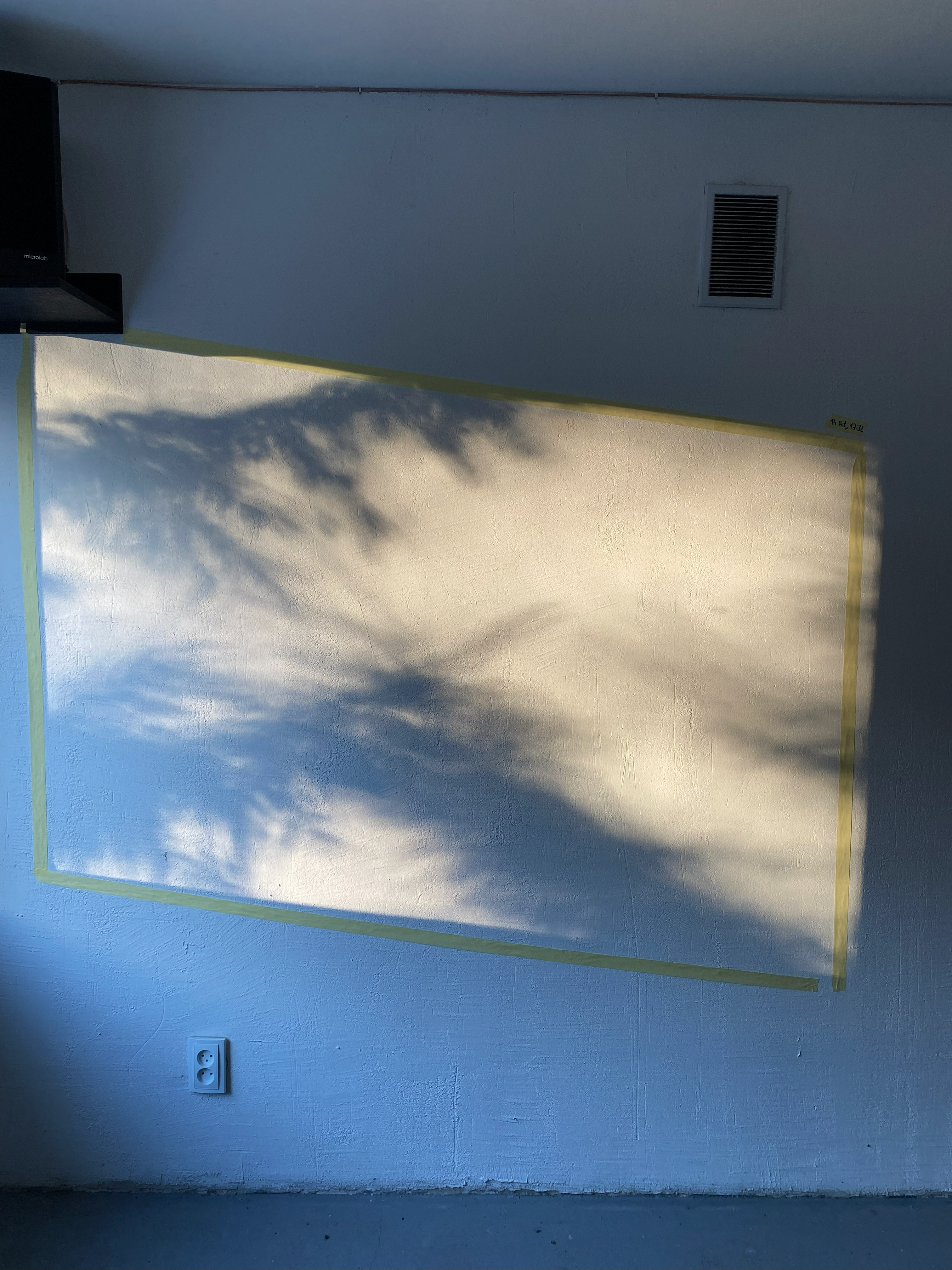
M. Ambrózy and R. Hazekamp, 17 October, 17:32 , 2025, digitalphotograph, Vilnius.